AI decision cycles completed — assistant sessions and recurring pipeline reviews
Commercial interactions unified into one shared relationship timeline
Demand signals routed into governed commercial workflows
The problem
Where it started.
Commercial work was spread across tools that did not share context. Outbound prospecting generated a steady stream of potential leads and conversations, but those records sat outside the CRM and could not be reliably triaged, deduplicated or connected to existing relationships.
Client history lived in individual inboxes. Pipeline hygiene depended on memory. Daily activity reporting and weekly reviews required manual assembly, while company-level website interest produced no usable signal for the commercial team. The goal was not simply to consolidate tools, but to build an operating system in which AI could assist with revenue work without being trusted to act unsupervised.
What we built
The system.
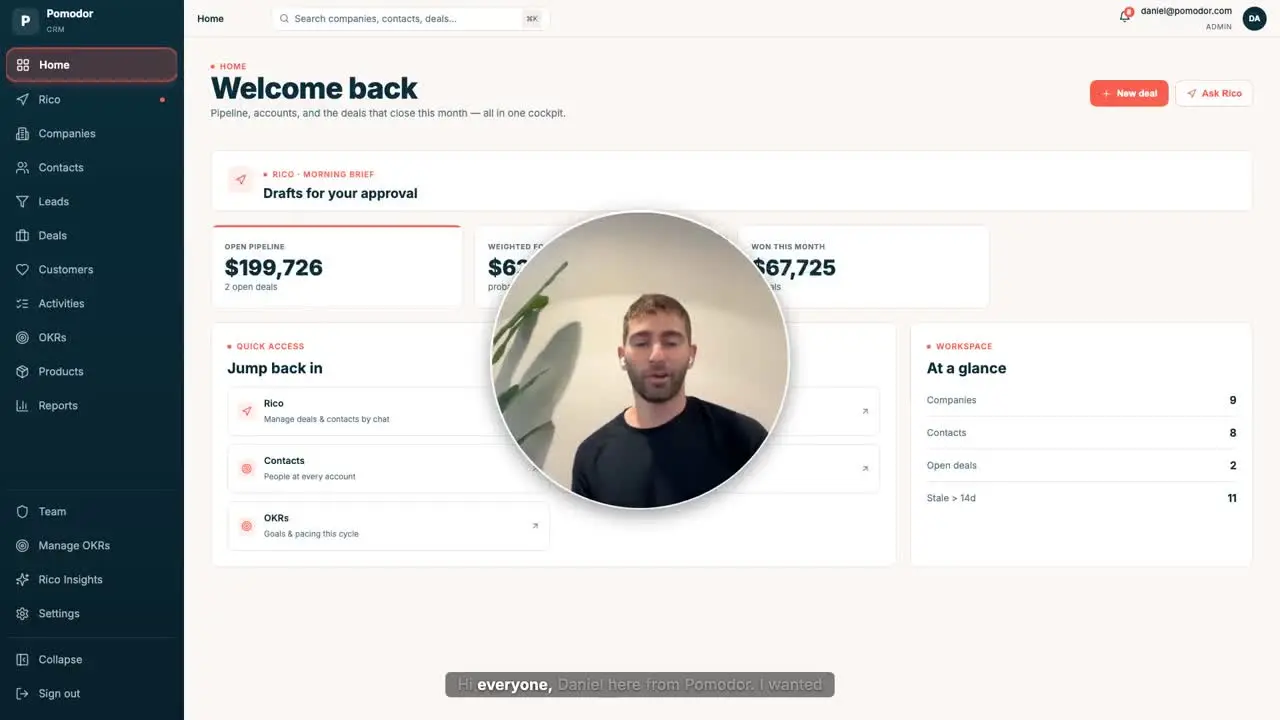
A unified revenue system combining CRM, communications capture, demand intelligence and a governed AI layer, supporting the full path from first signal through active pipeline and delivery handover.
Application layer: TanStack Start / React application deployed on autoscaling infrastructure, with Supabase Postgres, database-enforced row-level security, scheduled jobs and controlled access paths behind it.
Structured CRM records for contacts, companies, leads, deals, activities, customers, products and OKRs, with an enforced Contact → Lead → Deal path, a lead-pipeline Kanban and multi-currency reporting on daily FX rates.
Per-user email connection with a privacy gate: only mail matching an existing CRM contact is captured, linked to the relevant contact, lead and deal in one shared timeline. Personal mail is never ingested.
Lead-generation conversations across email, LinkedIn and SMS enter the same timeline through authenticated integrations and scheduled reconciliation, with deduplication and opt-out awareness, and users can reply through the connected channel.
A Gemini- and Claude-powered revenue assistant giving natural-language access to live CRM data in the app and in Slack for research, record updates, activity logging and scoped actions.
Proactive workflows that draft first-touch outreach, propose follow-ups and stage moves for at-risk deals, prepare meeting handoffs, analyse deal threads and produce recurring pipeline reviews.
Demand intelligence: a lightweight, cookieless website snippet identifies visiting companies from network data without person-level tracking, then scores and routes engagement to a ranked commercial inbox.
What changed
The result.
Commercial data, communications and demand signals now operate from one system of record. Relationship history is captured without manual logging, leads arrive through a governed ingestion path, and pipeline risk is surfaced proactively rather than being discovered in a meeting after it has become a problem.
The AI layer has been deployed as a controlled operational colleague: it accelerates drafting, analysis and follow-up preparation, while the team retains authority over external communications and material commercial actions. The build is live and designed to expand autonomy only as controls and trust permit.
Operational outcomes
Shared relationship context
Commercial interactions are captured, connected and available to the team without manual activity logging.
Governed demand intake
Prospecting and company-level interest enter structured workflows rather than remaining in disconnected tools.
Proactive revenue operations
Recurring digests, pipeline reviews and AI-assisted recommendations identify work that requires attention.